Why Might An Underwater Treadmill Be Used In Canine Rehabilitation?
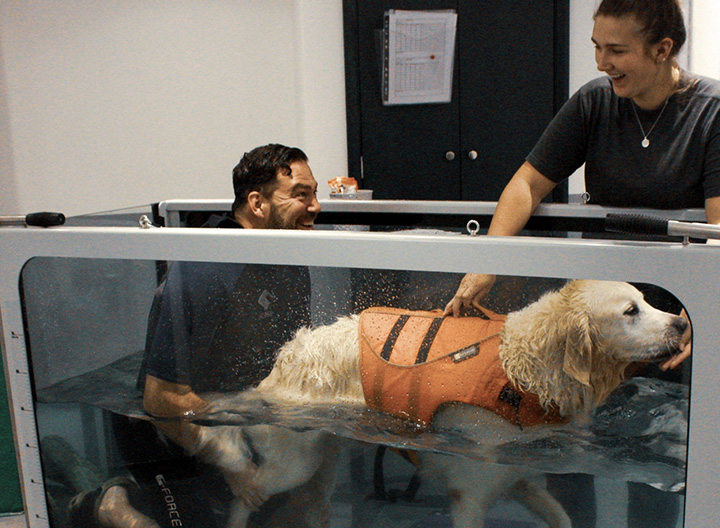
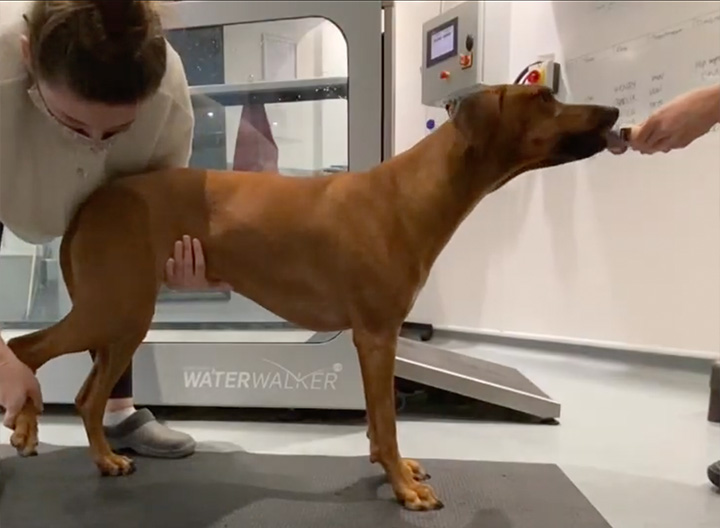
An underwater treadmill can be a valuable part of a canine rehabilitation programme, particularly for dogs recovering from surgery or experiencing neurological problems.
Unlike simply taking a dog for a swim, an underwater treadmill provides a controlled environment where movement can be carefully guided and monitored.
Here, we explore exactly what treadmill hydrotherapy for dogs is, and how it works.
How does an underwater treadmill for dogs work?
An underwater treadmill combines walking with the supportive properties of water. The depth of the water can be adjusted according to the individual dog's needs, while the treadmill provides a controlled surface on which to practise movement.
The water can reduce some of the weight placed through the limbs, making movement more manageable for certain dogs. At the same time, the resistance of the water can provide an opportunity to work on strength and controlled movement.
The aim isn't simply to make exercise easier. The underwater treadmill can provide a structured environment in which specific movement patterns can be practised safely and progressively.
Why might treadmill hydrotherapy for dogs be used after surgery?
Following surgery, a dog may need to rebuild strength and learn to move normally again while protecting the recovering area.
An underwater treadmill can form part of this process where appropriate. The controlled environment allows rehabilitation professionals to manage the intensity and nature of the exercise rather than relying on unrestricted activity.
Post-operative rehabilitation can be particularly important when a dog has experienced reduced activity and therefore lost some muscle strength or confidence in using a limb.
The underwater treadmill is one tool that may help support a gradual return to purposeful movement as part of the wider rehabilitation plan.
How can treadmill hydrotherapy for dogs help with neurological rehabilitation?
Neurological conditions can affect the way a dog stands, walks, balances or coordinates their movements. In these cases, rehabilitation may focus on helping the dog practise appropriate movement and make the best use of their remaining abilities.
The underwater treadmill provides an opportunity to work on controlled walking in a supportive environment.
This can allow rehabilitation professionals to concentrate on aspects such as foot placement, weight-bearing, coordination and purposeful movement, depending on the individual case.
Because neurological rehabilitation can be complex, sessions need to be carefully managed rather than treated as ordinary exercise.
Where does treadmill hydrotherapy fit into canine rehabilitation?
The underwater treadmill should be viewed as one element of a broader canine rehabilitation journey. In some cases, it may be combined with pool sessions and/or physiotherapy, alongside a professionally recommended home exercise programme.
For suitable neurological and post-operative cases, carefully supervised treadmill sessions can provide an opportunity to practise controlled movement in a supportive environment, while allowing rehabilitation professionals to adapt the session as the dog progresses.
The ultimate aim is to help each dog work towards improved movement, strength, coordination and function in a safe and purposeful way.
-
Previous